
In late 2010, a street vendor in Tunisia sparked a wave of demonstrations across the Middle East that reshaped the region’s political landscape. Known as the Arab Spring, this series of uprisings was not orchestrated by a traditional political party or fueled by a charismatic figurehead. Instead, it was coordinated through Facebook pages, Twitter feeds, and encrypted messaging apps.
Fast forward to the present day, and this pattern has become the global standard for public mobilization. From Black Lives Matter to climate strikes and digital activism, the way people organize, protest, and demand accountability has fundamentally transformed.
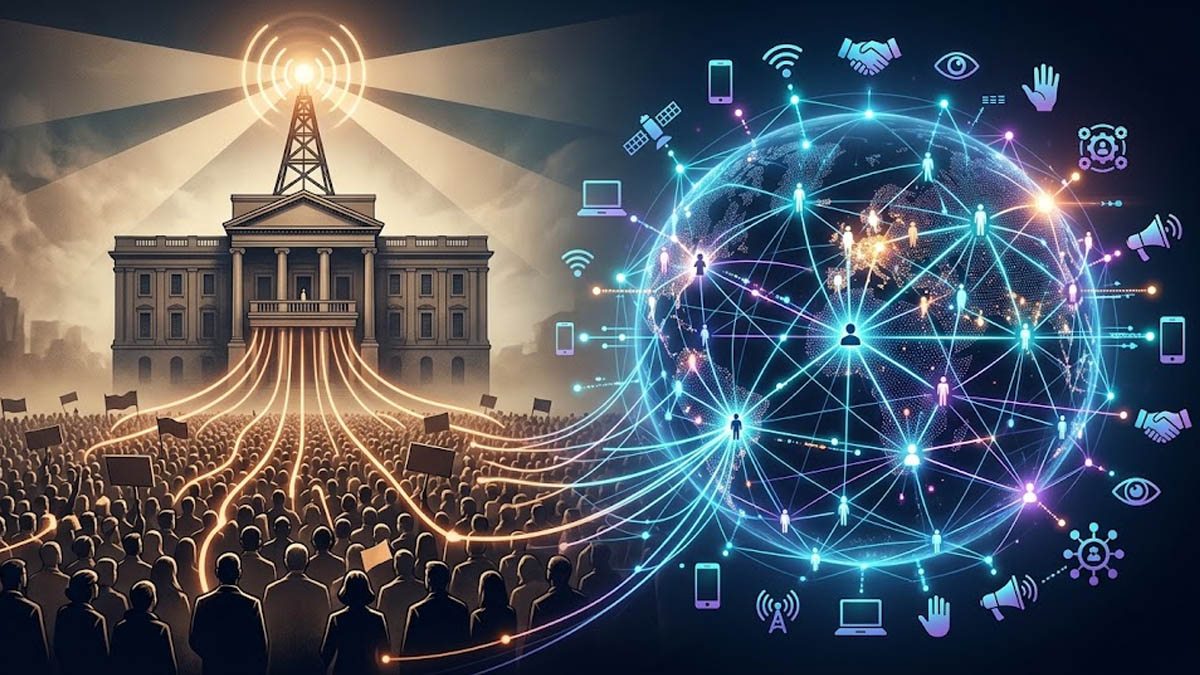
We are witnessing a profound historical transition: the shift from Mass Politics to Networked Politics. This evolution is not merely a upgrade in communication technology; it represents a fundamental overhaul of power, participation, and civic identity.
The Era of Mass Politics: Hierarchy, Parties, and Gatekeepers
To understand where we are today, we must look back at the 19th and 20th centuries. The rise of industrialization, urbanization, and broadcast technologies gave birth to the era of mass politics.
During this period, political engagement was highly structured, centralized, and institutionalized. Several key features defined this epoch:
The Dominance of Institutional Mobilization
Citizens participated in political life primarily through formal membership. Political parties, labor unions, and religious institutions served as the central conduits for political agency. Loyalty to these institutions was often lifelong and deeply tied to social class or community identity.
Mass Media as the Central Gatekeeper
Information flowed strictly top-down. Newspapers, radio, and television stations held immense power as gatekeepers. They determined what issues reached the public agenda, framing political debates and setting the boundaries of acceptable discourse.
Collective Action via Hierarchical Power
Organizing a strike, rally, or campaign required significant infrastructure. Leaders at the top issued directives, middle management coordinated logistically, and the masses carried out the action. Without institutional backing and financial resources, grassroots movements rarely gained traction.
While mass politics brought stability, ideological coherence, and clear negotiating channels, it also positioned ordinary citizens as passive consumers of politics rather than active participants.
The Digital Catalyst: The Birth of Networked Politics
The turn of the 21st century brought ubiquitous internet access, smartphones, and social media platforms, destabilizing the centralized architecture of mass politics. Sociologist Manuel Castells coined the term networked social movements to describe how digital networks enable decentralized, horizontal political action.
In networked politics, the mechanics of organizing and expressing dissent have undergone a radical transformation:
Leaderless Movements and Horizontal Networks
Digital networks allow individuals to self-organize without relying on formal hierarchies or recognized leaders. Anyone with an internet connection can initiate a campaign, launch a petition, or document state overreach, allowing movements to scale globally in a matter of hours.
From Collective Action to Connective Action
Political scientists Lance Bennett and Alexandra Segerberg distinguish traditional collective action (which requires shared organizational identities) from connective action. In connective action, personal expression drives participation. People join movements not because they agree with an entire party platform, but because a specific issue resonates with their personal values. Hashtags act as fluid framing mechanisms that unite diverse voices under a single banner.
Bypassing Traditional Gatekeepers
Social platforms empower citizens to bypass traditional media filters. Raw footage, eye-witness accounts, and alternative narratives circulate directly among peers, making it increasingly difficult for governments or media conglomerates to control the narrative.
The Double-Edged Sword of Networked Politics
While the transition to networked politics offers unprecedented democratization, it also presents significant challenges for modern governance.
The Promises: Inclusivity and Rapid Accountability
Networked politics lowers the barrier to entry for civic participation. Marginalized groups, youth movements, and local communities that were historically ignored by mainstream political parties now possess a global megaphone. Public officials face real-time accountability, as policy blunders or corrupt actions can trigger immediate public backlash.
The Pitfalls: Polarization, Disinformation, and Fragility
Conversely, algorithmically driven platforms thrive on outrage, often creating echo chambers and exacerbating social polarization. The same networks that facilitate democratic protest can be weaponized to spread state-sponsored propaganda, deepfakes, and conspiracy theories.
Furthermore, author and scholar Zeynep Tufekci points out that because networked movements scale rapidly without building organizational infrastructure, they often struggle with long-term strategy, negotiation, and policy implementation. They are fast to mobilize, but fragile under sustained pressure.
Navigating the Future of Civic Engagement
The shift from mass politics to networked politics does not mean traditional institutions are obsolete; rather, it highlights their urgent need to adapt. Governments and political parties that continue to operate on top-down, 20th-century logic risk complete alienation from an increasingly networked citizenry.
The future of democracy will depend on our ability to bridge this gap—combining the agility, inclusivity, and reach of digital networks with the durability, accountability, and institutional weight necessary to achieve lasting societal progress.